Walk into any serious gym and you will see leather and nylon cinched around waists of every size. This is nothing new. Weightlifting belts have a long history in the gyms and lifting
Some strap it for every single exercise. I mean, it's hard not to laugh at the sight of them. Forearm curls? Belt on! Lat pull-downs? belt on! Deadlifts? Of course, are you kidding me? belt on! maybe even two grip trainings? Well, can't do without my belt. Every time they set foot in the gym, they wear it like their lives depended on it. Then there are others who view with suspicion. These lifters somehow have come to believe that a belt acts as a crutch that supposedly creates a weak core.
Both extremes miss the point entirely. A weightlifting belt is neither an armored back brace designed to magically fix terrible mechanics, nor is it a shortcut that atrophies your abdominal muscles. Used correctly, it is one of the most reliable performance tools, whether you're a casual lifter or a serious power lifter.
What a Lifting Belt Actually Does and What It Doesn't
The Science of Intra-Abdominal Pressure (IAP)
Okay, let's address this first.
To understand what a belt does, you first have to understand how your body stabilizes under heavy spinal loading.
When you prepare to squat, deadlift, or press a heavy load, your brain initiates a natural stabilization reflex known as the Valsalva maneuver. You take a deep diaphragmatic breath, drawing air into your belly and lower ribs rather than raising your chest and close your glottis (the vocal cords in your throat). As you contract your abdominal wall, oblique muscles, and pelvic floor against this trapped air, you create intra-abdominal pressure (IAP).
Think of your torso as an empty aluminum soda can versus an unopened, pressurized one: An empty, open can crushes easily when stepped on. A sealed, pressurized can will support an adult's body weight without buckling.
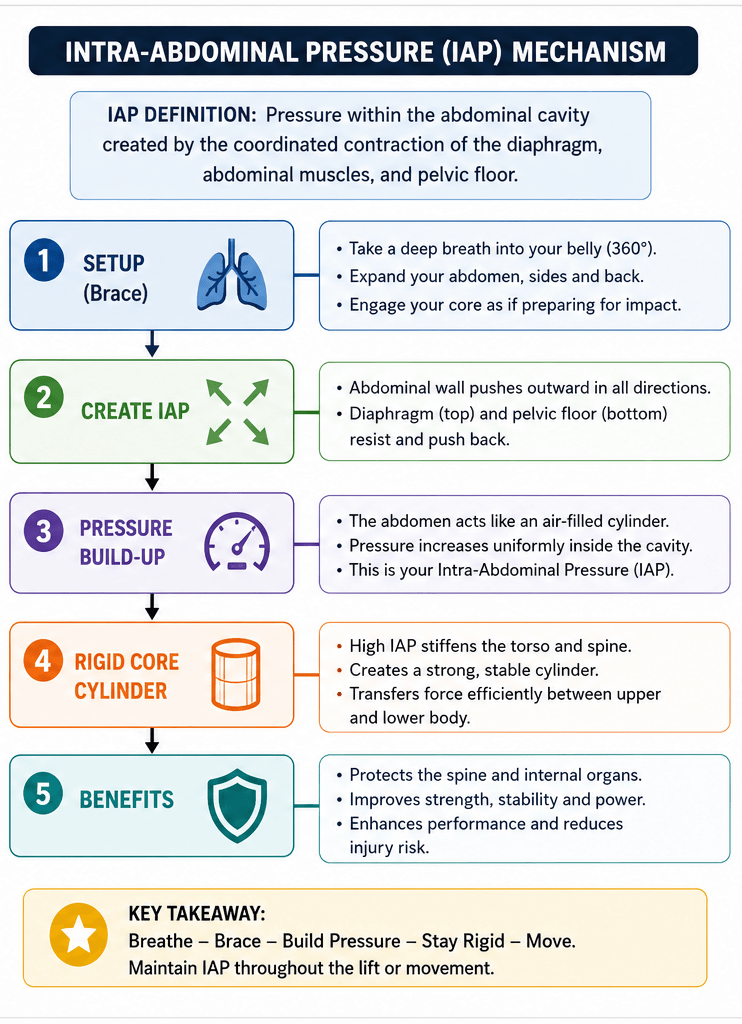
Contrary to the popular misconception, a lifting belt DOES NOT actively "hold you up" like a medical corset. Instead, it provides an unyielding external perimeter for your abdominal wall to expand against. In other words, this means you can be damn sure that without proper form you will get injured with or without wearing a belt.
When your core pushes against the rigid wall of the belt, your internal pressure spikes by 20% to 40% higher than without one. This rigid hydraulic cylinder stabilizes your lumbar spine, minimizes unwanted lumbar flexion under load, and increases prime mover recruitment in your hips and legs.
Debunking the "Weak Core" Myth
As mentioned earlier, the belief that using a belt makes your core weak has been thoroughly disproven by electromyographic (EMG) studies. Research measuring abdominal muscle activation (rectus abdominis, obliques, and erector spinae) during belted versus unbelted squats consistently finds that muscle activation is equal to or slightly higher with a belt.
Because the belt gives your nervous system proprioceptive feedback (something firm to push against), you can brace harder. You are training your abdominal musculature to produce maximum force against resistance.
When Should You Start Wearing One?
You do not need a belt on day one. Beginners should first learn how to brace naturally and execute compound movements with solid motor control.
Once you have established reliable mechanics and your working sets move past your body weight (roughly 1.2x to 1.5x bodyweight squats and deadlifts), adding a belt enables higher training volumes, greater bar velocity, and safer overload without technical breakdown.
2. Technical Anatomy: Materials, Thickness, Width, and Buckles
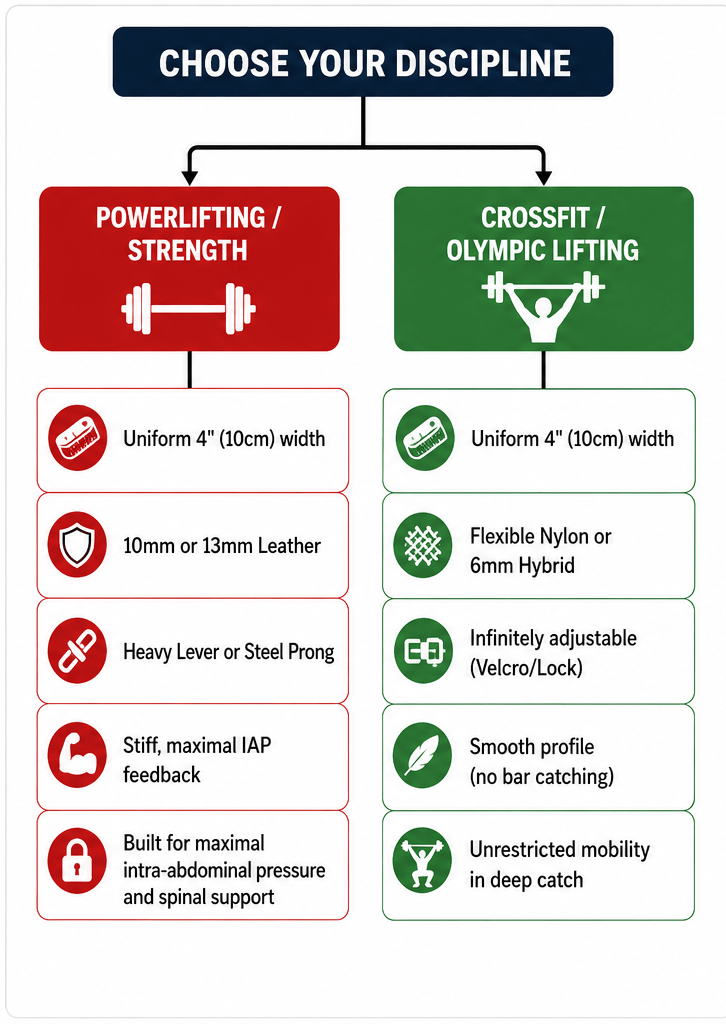
Lifting belts are not one-size-fits-all tools. The right belt for a 600 lb deadlift in a powerlifting meet will ruin your workout during an Olympic clean-and-jerk or high-rep CrossFit metcon.
Material: Leather vs. Nylon
Sole Leather / Vegetable-Tanned Leather: The gold standard for raw strength. Cut from thick cattle hide, leather provides maximum rigidity and minimal stretch under hundreds of pounds of pressure. It takes time to break in, but a high-end leather belt can last decades.
Nylon: Lightweight, flexible, and soft on the ribs. Nylon belts wrap with heavy-duty hook-and-loop Velcro and steel roller buckles. They do not match the sheer radial stiffness of 10mm/13mm leather, but they allow rapid transitions between movements and dynamic hip flexion in cleans and snatches.
Thickness: 6mm vs. 10mm vs. 13mm
6mm – 7mm: Common in hybrid belts or Olympic-specific leather belts. Highly pliable from day one, offering good tactile feedback without digging into your hips.
10mm: The sweet spot for 85% of lifters. Thick enough to handle world-class powerlifting loads, yet supple enough after a short break-in period to contour comfortably to your waist.
13mm: The maximum legal limit for competitive powerlifting. Extremely rigid and heavy. A 13mm belt provides an immovable bracing wall but requires significant break-in and can bruise your ribs or hip crests if you have a shorter torso.
Width: 4-Inch Uniform vs. 3-Inch vs. Tapered
4-Inch (10cm) Uniform: Standard width across powerlifting federations (IPF, USAPL, USPA). Supports the back and abdominal wall equally.
3-Inch Uniform: Built for shorter lifters, lifters with a narrow gap between their rib cage and iliac crest, or for deadlifting where a 4" belt pinches at the bottom of the pull.
Tapered (4" Back, 2.5" Front): Traditional bodybuilding style. Tapering allows easy forward bending but compromises anterior abdominal support where intra-abdominal pressure needs it most. Generally inferior for heavy powerlifting compared to a uniform width.
Closure Types: Prong vs. Lever vs. Self-Locking
| Closure Type | How It Works | Strengths | Drawbacks |
| Traditional Lever | Steel plate clamp with fixed prongs that snap shut. | Ultra-fast on/off; tightest possible cinch with zero effort. | Requires a screwdriver to change sizes if you gain weight or adjust between squat and deadlift. |
| Adjustable Lever (SBD / PAL) | Patented sliding or offset mechanisms. | All the speed of a lever combined with instant prong-like adjustability. | Expensive; adds front bulk. |
| Single Prong | Heavy steel tongue through reinforced hole. | Simple, indestructible, and easy to adjust tight or loose per exercise. | Unbuckling a tight belt after an exhausting set can be difficult. |
| Double Prong | Two parallel prongs. | Classic aesthetic. | Frustrating to align; offers zero structural advantage over a single prong. |
| Self-Locking / Velcro | Nylon strap through a roller bearing with hook-and-loop closure. | Infinite micro-adjustability, light, and fast release during conditioning. | Velcro eventually wears out, with lower maximum radial support than leather. |
3. Comparison of the Top Weightlifting Belts
| Belt Model | Primary Discipline | Material | Thickness |
| SBD 13mm Lever | Powerlifting / Heavy Strength | English Leather & Red Suede | 13mm |
| Pioneer PAL V2 | Powerlifting / Strongman | 100% US Vegetable-Tanned Sole Leather | 10mm or 13mm |
| Rogue Ohio Belt | General Strength / CrossFit | Natural Tanned US Leather | 10mm |
| Gymreapers Lever | Powerlifting / Bodybuilding | Genuine Leather & Suede | 10mm or 13mm |
| Inzer Forever Lever | Powerlifting / Legacy Strength | Multi-Layer Bonded Leather | 10mm or 13mm |
| Element 26 Self-Locking | CrossFit / Olympic Weightlifting | 100% Premium Nylon | ~5mm |
| 2POOD Straight Belt | Functional Fitness / Oly Lifting | High-Density Nylon | ~5mm |
| Dark Iron Fitness | Budget Lifting / Home Gym | Buffalo Leather | ~4mm |